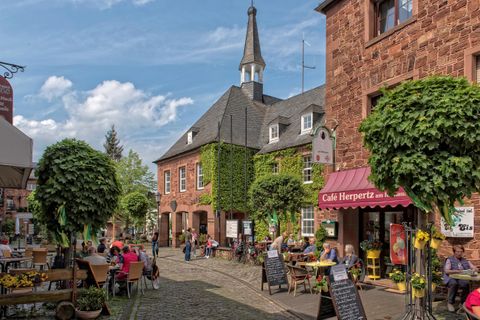
Together with the parish church of St. Johannes, the town hall, the district court and the historic market place, the buildings still to come form the structural core of the city.
The Gallo-Roman cemetery near the road (between Wasserbillig and Lellig) was discovered in 1970. The finds of the Gallo-Roman grave can be dated to between 75 and 100 AD, and suggest that those buried here belonged to a rich family.
The Josefskapelle in Lind was expected to be completed in 1860 after the first chapel had to be demolished in 1856 due to dilapidation. The new chapel was solemnly consecrated on March 19th, 1858. In 1994, a sacristy was built east of the choir, which is used by the pastor and the altar boys to prepare for Holy Mass.
An sculpture of the virgin Maria. The sculpture is 2 meters high and stands on a pedestal of 6 meters high. The sculpture is built in 1956 during a project with the citizens of Oberbettingen.