The former Premonstratensian monastery from the 12th century is located in the austere Eifel landscape, in the middle of the "High Fens" nature park, right on the German-Belgian border. The complex, which includes over 32 hectares of forest and a fish pond, is located on a rock plateau at the mouth of the Rur, which meanders in the valley between Kalterherberg and Eschweide, and the Ermesbach. It is 7 km to the picturesque town of Monschau.
Immerse yourself in the world of Henri Tudor, the inventor of the lead accumulator. At the Tudor Castle in Rosport, the former residence of Henri Tudor (1859-1928), you will experience the development of electricity and innovations. The visitor learns the current and accumulator interactively.
Until far into the 19th century millstone were carved out in the caves. But the caves also were used as natural "refrigerators". In the winter time they were equipped with ice and snow so that cooling conditions kept the cold far into the summer.
National Geopark Laacher See Geological heritage of the East Eifel The largest lake in Rhineland-Palatinate, the Laacher See, is at the center of the Laacher See National Geopark, which was newly formed in 2016. The Geopark Laacher See extends from Andernach am Rhein over the Brohl valley near Niederzissen north of Laacher See. In the east, the area extends into the Eifel near Boos and includes the entire volcano park from Mayen via Mendig to Kaltenengers.
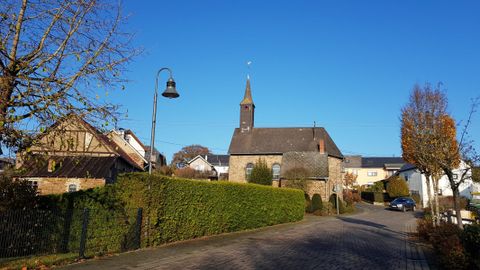
Today's St. Apollonia Chapel in Hirten (Untere Dorfstraße 2) was built in 1785 in honor of the holy Apollonia and solemnly consecrated on July 12, 1785.