Ehrenkreuz Riethel
VolkesfeldThe honor cross was inaugurated on the "Riethel" on November 18, 1954 as a cross of honor for those who fell in the First and Second World Wars.
The honor cross was inaugurated on the "Riethel" on November 18, 1954 as a cross of honor for those who fell in the First and Second World Wars.
Campground at the sports field "Auf der Lay" in Üxheim-Niederehe.Information and reservations at the mayor of Üxheim: buergermeister@uexheim.de or via phone number +492696/1281
During the Middle Ages, Schloss Bürresheim palace was actually a castle, in other words, a knight’s residence and a fortress at the same time.
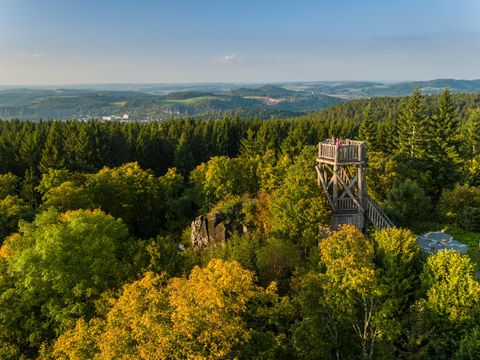
About 50 m northwest of the mountain top of the 560 m high mountain "Gänsehals" stands the Gänsehalsturm, a 74 m high radio tower, which also serves as a viewing tower.
Touch, grasp and understand - this is what distinguishes the interactive museum Vulkanhaus Strohn.
Enjoy Italian specialties!
chapel Adenau chapel "Marienkapelle", built between 1893 and 1895 instadt of an older chapel, is a jewel of Adenau.
Visit the Vulkanmuseum Daun and experience the fascinating history of volcanism!
The listed building is not only being used as living quarters but also as a place to offer high-quality cultural venues. Theatre, concerts and exhibits take place inside and outside the castle.
The watercourses and their floodplains are a typical and ecologically valuable part of the Rureifel with a great wealth of flora and fauna. This diversity is thanks to the farmers who have mowed the meadows for centuries. When modern forms of farming close to villages made haymaking in the valleys no longer worthwhile, spruce trees were planted there. Efforts are currently being made in many places to restore the original floodplain vegetation. The characteristic terracing can be seen in many places along the hiking trail. This occurs when a river is no longer able to transport its debris and deposits it in the floodplain. If a river deepens again due to a change in climate, it cuts through the previously formed terrace. The formerly swampy valleys of the Eifel only acquired their function as traffic routes after the river regulation at the beginning of the 20th century.