„D’r övverschte Willms“
Stolberg
Hubert Willms' Widow's Restaurant
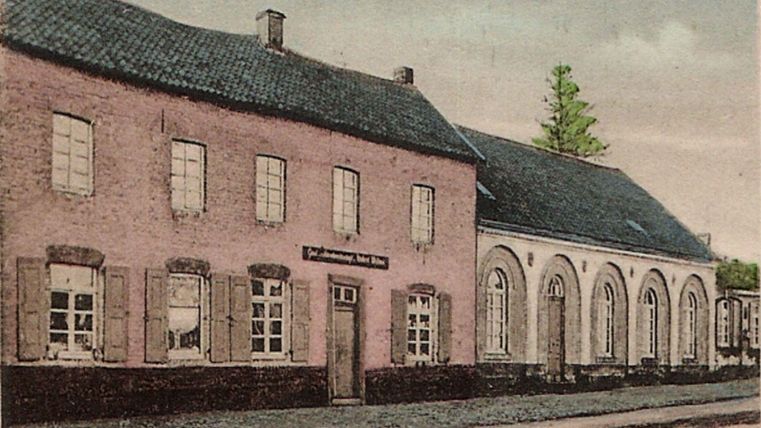
A postcard from 1896 confirms that the Hubert Willms Restaurant had been in operation since the 19th century. At that time, the owner was Hubert Willms (1826–1897). After his death, his widow, Elisabeth, née Quast (1830–1911), continued to run the restaurant. Later, Elisabeth Willms, married name Limburg (1867–1936), took over the business.
The restaurant was located on Diepenlinchener Straße, slightly below the restaurant owned by Peter Willms, Hubert Willms’s nephew. Locals distinguished between the two establishments based on their location: the “upper Willms” and the “lower Willms”—in the local dialect, “övverschte” and “öngerschte” Willms.
A shared nickname arose from an anecdote: At the “övverschte” Willms, the owner would read the world news from the newspaper to his guests. One day, a news item mentioned the Italian region of Piedmont, which the owner pronounced “Pimmong.” This led to general merriment. Thus, the restaurant earned the nickname “övverschte Pimmong,” while Peter Willms’s restaurant was given the name “öngerschte Pimmong.”
On April 9, 1882, several residents of the community who were very interested in home music decided to found the music association “Euphonia.”
The minutes documenting the founding and meetings held at Willms’s tavern were destroyed in a fire in 1902, so unfortunately, a complete history of the association’s development up to 1902 cannot be presented. As far as can be determined, the founders of the association included: Anton Willms, Peter Schür, Jakob Mohr, Wilhelm Johag, Peter Willms, Matthias Hanf, Hubert Mohr, Franz Josef Scholl, Jakob Willms, Ludwig Karl, Johann Wildt, Josef Schür, Peter Mohr, and the Moonen brothers. The purpose and goal of the association was to promote instrumental music for the enjoyment of its members and to organize public concerts. The association’s chronicle names the musician Erdmann from Eilendorf as its first conductor.
For decades, F. J. Scholl, as conductor, positively influenced the association’s fortunes. Three qualities helped him overcome all difficulties: a strong sense of order, discipline, and his deep musical understanding.
At the outbreak of the war in 1914, the “Euphonia” accompanied the first soldiers from Mausbach to Stolberg to the sounds of their instruments, “
.” During the war, the association’s large drum went to Russia with the 28th Landwehr Regiment. Of the seven members who went to war, Josef Heidbüchel, Wilhelm Schiffer, Wilhelm Johag, and the Lauscher brothers died for their homeland and their country.
This route was developed as part of the LEADER-funded project “Quality Hiking Initiative in Roetgen and Stolberg” with support from the European Union (EAFRD) and the state of North Rhine-Westphalia.
Impressions

Contact
Panoramarundweg Mausbach
52224 Stolberg