Siedlung Diepenlinchen
Stolberg
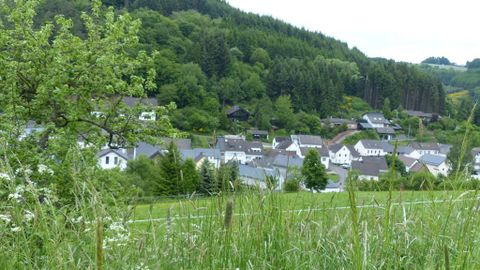
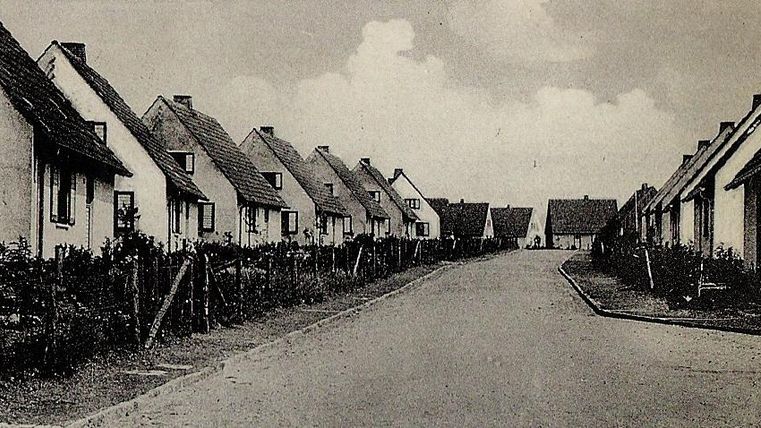
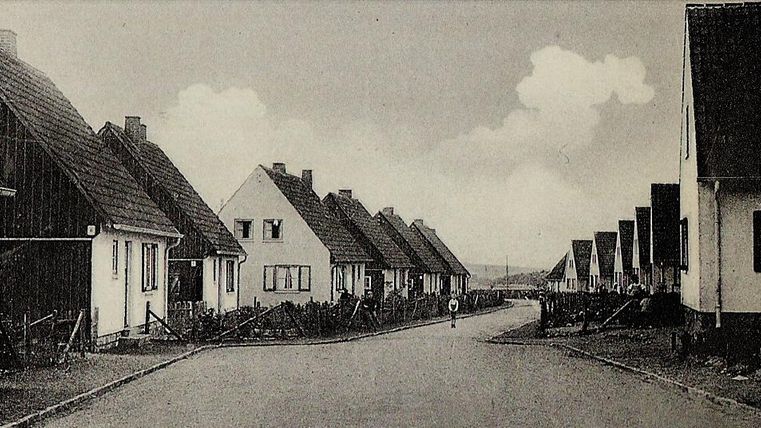
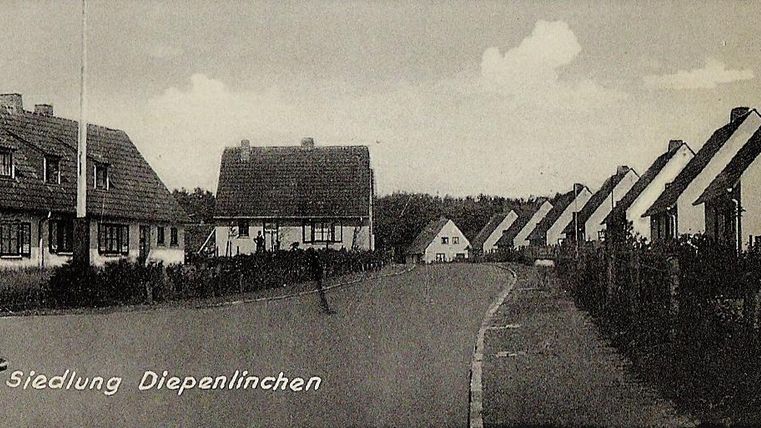
Diepenlinchen Housing Development – Apartments for 56 Families (1936)
Since records regarding the founding of the Diepenlinchen housing development are not immediately available, one must consult the existing information on the comparable founding of the Broich and Bardenberg housing developments for this purpose. It quickly becomes apparent that these housing developments were job-creation measures implemented during Germany’s political upheaval under the Third Reich. The construction of these housing estates was carried out with great propaganda fanfare and overseen by Dr. Robert Friedrich Ley, Reich Leader of the German Labor Front (DAF) and later Reich Organizational Leader of the NSDAP. During this period, Ley was one of the five highest-ranking Nazi leaders.
The housing development, built in 1936, was intended, first, to provide the families moving in with a new home. Second, the large gardens were meant to support self-sufficiency. For this reason, each of the 56 plots covers an area of 1,000 m².
The first settlers attempted to cultivate the plots of land assigned to them using peat and spades. In addition, all families were given small livestock (chickens, geese, and ducks) to supplement their food supply.
In 1950, the settlement was rebuilt by the families who remained. The community at that time decided to erect a memorial in honor of the fallen. It was dedicated in 1956. From 1950 to the present day, families in their third generation have been living in these homes. Renovations and improvements are constantly being made. Volunteers take care of maintaining the memorial. Solidarity is still very much alive in the settlement community today. Everyone is there for one another.
To this day, family celebrations bring the members together.
This route was developed as part of the LEADER-funded project “Quality Initiative for Hiking in Roetgen and Stolberg” with support from the European Union (EAFRD) and the state of North Rhine-Westphalia.
Impressions
Contact
Panoramarundweg Mausbach
52224 Stolberg