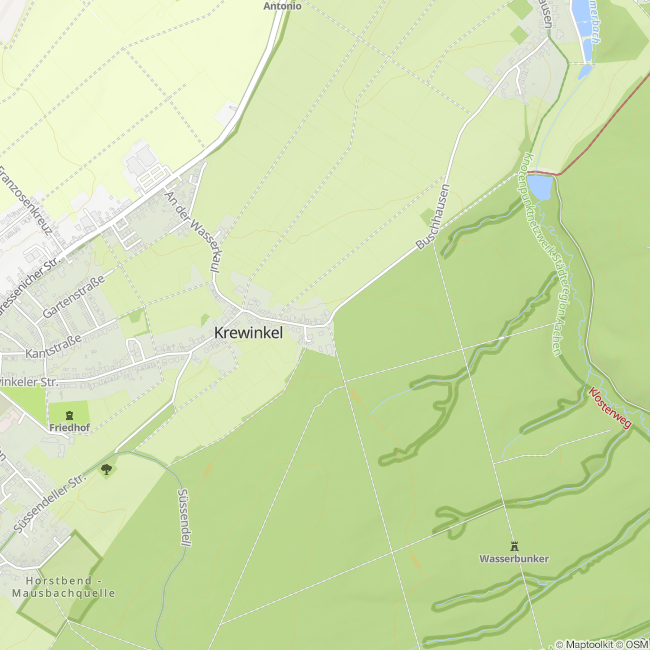
Krewinkel
Stolberg
A settlement on either side of the Roman road
The earliest settlement activities in Krewinkel can only be indirectly traced through the Roman road that crosses the village. Roman roads often followed the contour lines for defensive reasons, and the route at this point offered a wide view into the Aachen, Jülich, and Düren region. These roads primarily connected larger settlements and were to be understood as long-distance road networks. It is assumed that the road was built first and the settlement of Krewinkel only developed afterward. The residents benefited from both the protection of a constant military presence and economic opportunities, such as offering inns or provisions for travelers and their animals.
Unfortunately, nothing is known about the time of the establishment of the village. However, in 1336, a "Heynone de Krewinckel" (Heyno of Krewinckel) is already mentioned among the aldermen of Gressenich.
The spelling of the village name has changed repeatedly over the centuries. When reviewing old documents, the following names can be found:
Krewinckel 1336
Crewinckel 1470
Crewinckell 1513
Krähewinkel 1531
Krehwinckel 1569
Krehewinckell 1648
Krehwinkel 1708
Kriewinkel 1787
Kriewinckel 1810
As early as 1731, the spelling is found in its current form.
Pastor Ortmanns interpreted the name as referring to crows that were driven away in case of intrusion, but there is no solid historical evidence for this.
The old Roman road served as the boundary between the possessions of the Kornelimünster monastery and those of the Dukes of Jülich from 844 to 1796, so Krewinkel was originally divided. The part west of the road initially belonged to the Frankish royal court Gressenich (Grasciniacum) and was gifted to the Kornelimünster monastery by Ludwig the German on March 26, 844, along with all servants and rights.
Impressions
Contact
Panoramarundweg Mausbach
52224 Stolberg